AR Car Parking
AR Car Parking
Content
Category
AR/VR
Challenges
There is a growing need for an immersive driving simulation that closely mirrors real-world physics to make learning practical and meaningful. Many traditional driving games lack realistic interaction, especially when it comes to essential skills like parking, reversing, and maneuvering in tight spaces. Without accurate feedback, learners struggle to develop confidence and precision. A major challenge is effectively conveying car size, turning radius, and blind spots, which are critical for real-world driving but difficult to represent in simplified environments. Players often misjudge distances and angles, leading to habits that do not translate well outside the game. Traditional 2D driving games further limit learning by failing to provide true depth and spatial awareness, reducing the experience to surface-level control rather than realistic understanding. These flat representations cannot replicate how drivers perceive space, movement, and obstacles in real life. To truly support skill development, simulations must offer realistic physics, depth perception, and interactive environments. By doing so, learners can safely practice, build muscle memory, and gain a deeper understanding of vehicle behavior, resulting in better preparedness and confidence for real-world driving scenarios.
Challenges
There is a growing need for an immersive driving simulation that closely mirrors real-world physics to make learning practical and meaningful. Many traditional driving games lack realistic interaction, especially when it comes to essential skills like parking, reversing, and maneuvering in tight spaces. Without accurate feedback, learners struggle to develop confidence and precision. A major challenge is effectively conveying car size, turning radius, and blind spots, which are critical for real-world driving but difficult to represent in simplified environments. Players often misjudge distances and angles, leading to habits that do not translate well outside the game. Traditional 2D driving games further limit learning by failing to provide true depth and spatial awareness, reducing the experience to surface-level control rather than realistic understanding. These flat representations cannot replicate how drivers perceive space, movement, and obstacles in real life. To truly support skill development, simulations must offer realistic physics, depth perception, and interactive environments. By doing so, learners can safely practice, build muscle memory, and gain a deeper understanding of vehicle behavior, resulting in better preparedness and confidence for real-world driving scenarios.
Challenges
There is a growing need for an immersive driving simulation that closely mirrors real-world physics to make learning practical and meaningful. Many traditional driving games lack realistic interaction, especially when it comes to essential skills like parking, reversing, and maneuvering in tight spaces. Without accurate feedback, learners struggle to develop confidence and precision. A major challenge is effectively conveying car size, turning radius, and blind spots, which are critical for real-world driving but difficult to represent in simplified environments. Players often misjudge distances and angles, leading to habits that do not translate well outside the game. Traditional 2D driving games further limit learning by failing to provide true depth and spatial awareness, reducing the experience to surface-level control rather than realistic understanding. These flat representations cannot replicate how drivers perceive space, movement, and obstacles in real life. To truly support skill development, simulations must offer realistic physics, depth perception, and interactive environments. By doing so, learners can safely practice, build muscle memory, and gain a deeper understanding of vehicle behavior, resulting in better preparedness and confidence for real-world driving scenarios.
Solutions
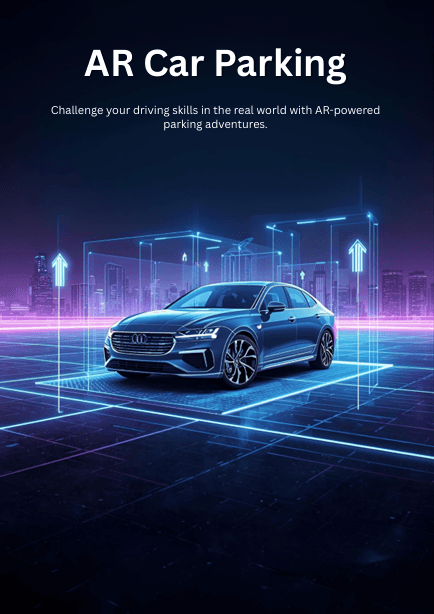
An immersive AR experience bridges virtual and physical spaces, allowing users to practice driving skills within their real-world environment. Realistic steering and gear overlays provide true-to-life control, helping users understand vehicle behavior and build muscle memory naturally. Full-scale and tabletop modes support better spatial understanding by letting users view vehicles at real size or in a scaled-down perspective for learning maneuvers and layouts. Markerless AR enables precise, real-world vehicle placement without the need for external markers, making the experience seamless, flexible, and highly accurate.
Solutions
An immersive AR experience bridges virtual and physical spaces, allowing users to practice driving skills within their real-world environment. Realistic steering and gear overlays provide true-to-life control, helping users understand vehicle behavior and build muscle memory naturally. Full-scale and tabletop modes support better spatial understanding by letting users view vehicles at real size or in a scaled-down perspective for learning maneuvers and layouts. Markerless AR enables precise, real-world vehicle placement without the need for external markers, making the experience seamless, flexible, and highly accurate.
Solutions
An immersive AR experience bridges virtual and physical spaces, allowing users to practice driving skills within their real-world environment. Realistic steering and gear overlays provide true-to-life control, helping users understand vehicle behavior and build muscle memory naturally. Full-scale and tabletop modes support better spatial understanding by letting users view vehicles at real size or in a scaled-down perspective for learning maneuvers and layouts. Markerless AR enables precise, real-world vehicle placement without the need for external markers, making the experience seamless, flexible, and highly accurate.
Content